

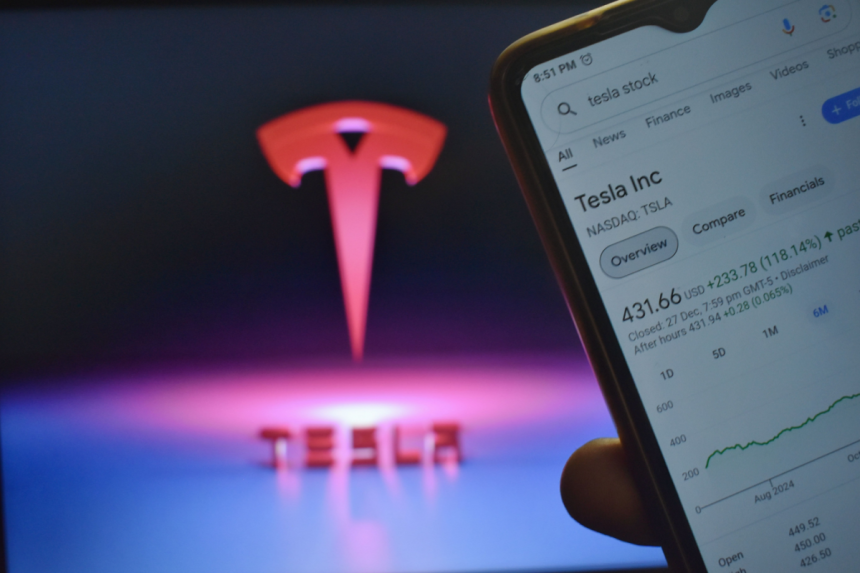
Tesla and Palantir have started the year under pressure, and a pair of bearish analyst calls is adding fuel to the debate over whether their valuations can hold up if growth expectations slip. In late February, GLJ Research reiterated a sell stance on Tesla with a $25.28 12 month price target. Separately, RBC Capital’s Rishi Jaluria reiterated a sell rating on Palantir with a $50 target ahead of the company’s fourth quarter results. Those targets imply large downside versus recent trading levels, and while the calls represent aggressive bear cases, they highlight the main risks the market is currently willing to pay for.
Tesla: The Stock Price Is About AI and Robots
The bearish thesis on Tesla is straightforward. The company’s valuation appears to be anchored more to its future in artificial intelligence, robotaxis, and Optimus humanoid robots than to the near term trajectory of its core electric vehicle business. Bulls argue that the next leg of value will come from software and autonomy, plus a new robotics platform that can scale beyond cars. Bears argue the timeline and adoption curve are being priced as near-certain outcomes.
GLJ’s critique centers on the idea that investors may be assigning too much probability to Optimus becoming commercially viable at meaningful scale. In the analyst’s view, the market is effectively pricing in a high likelihood of a future that the firm considers far less certain. That gap matters because even a strong long-term narrative can fail to support a stock if milestones arrive later than hoped, arrive smaller than hoped, or require far more capital and time than expected.
Robotaxi Ambitions Come With Competitive Friction
Tesla’s bull case also leans on autonomous ride hailing. The company has discussed expanding an autonomous taxi offering to many major cities by the end of 2026, and that concept naturally invites comparisons to ride-hailing leaders and self-driving competitors. A key challenge is not only technical execution, but also distribution and demand capture. Riders already live inside existing apps, and even companies in the self-driving ecosystem have often chosen to partner with platforms like Uber or Lyft to reduce customer acquisition costs and improve capital efficiency.
For Tesla to become a top ride-hailing provider, it would need to attract riders away from established platforms at scale. That can be harder than the product narrative suggests, especially if rivals match pricing, subsidize rides, or bundle offerings. If adoption is slower or more geographically limited, the market may have to reprice how quickly autonomy turns into durable revenue.
Core EV Trends and Margin Questions Still Matter
Even if investors care most about AI and robotics, Tesla’s core business still determines near term cash generation, manufacturing utilization, and headline growth. Analysts generally expect EV deliveries to improve in 2026, but not necessarily return to prior peaks. Meanwhile, Tesla’s approach to monetizing its Full Self-Driving capability is another variable. Shifting from upfront purchase to a subscription-only model can pressure near term gross margin recognition, while potentially improving the quality and predictability of long-term cash flow if subscriptions scale well.
Valuation is where the tension concentrates. A stock priced at a very high multiple requires a high level of confidence in future dominance. In this framework, Tesla bulls are effectively underwriting leadership in robotaxis and meaningful commercial adoption of Optimus. If either narrative is delayed or diluted, valuation compression becomes a risk even if the underlying business remains solid.
Palantir: Strong Momentum Meets a High Bar
Palantir’s recent performance has been supported by strong revenue growth and improving profitability, with management emphasizing momentum for its Artificial Intelligence Platform, which helps users integrate large language models into workflows built on Palantir’s data analytics foundation. The company has highlighted accelerating growth expectations and significant remaining deal value in U.S. commercial activity, alongside guidance that implies further margin expansion.
RBC’s bear case focuses on two areas. First, the firm points to concerns that government contract value may be weakening based on data checks, even as geopolitical uncertainty could support longer-term demand. Second, RBC raises questions about the sustainability of commercial growth, citing signs that some customers may be shifting away. If either the government pipeline cools or commercial demand proves less durable, Palantir could face a gap between narrative momentum and realized growth.
Valuation Risk Is the Common Thread
Even supporters of Palantir’s business model often acknowledge the stock’s valuation is doing a lot of work. When a company trades at very elevated multiples, the market is not only expecting growth, it is expecting that growth to persist for years with limited stumbles. That makes the risk profile asymmetric: strong results can be required just to justify the current price, while any slowdown, mix shift, or guidance reset can lead to rapid multiple compression.
The Tesla and Palantir debates share a similar structure. Both companies sit at the center of AI enthusiasm. Both have narratives that can be compelling. And both face the same investing reality: the higher the expectations embedded in the stock, the less room there is for execution to be merely good instead of exceptional.