


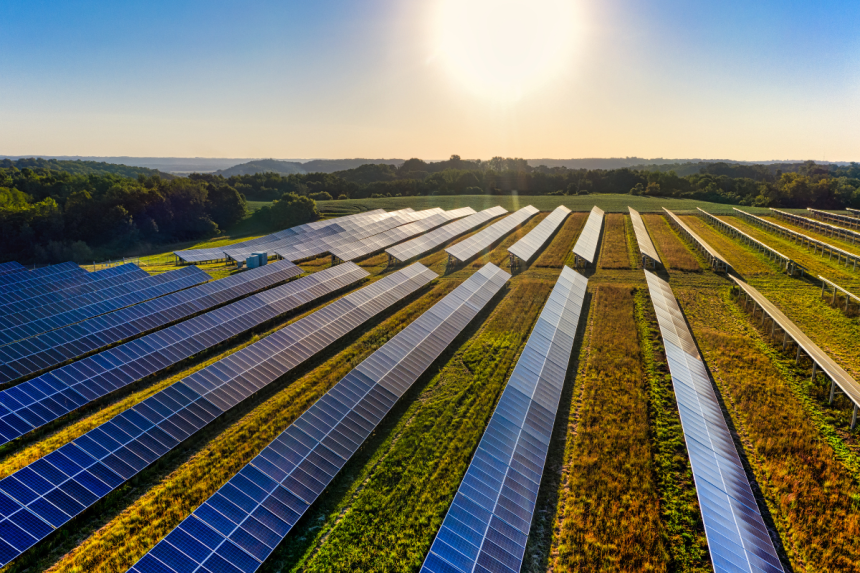
Unprecedented growth in global capacity
Since the beginning of the 21st century, solar energy has expanded more rapidly than any other power source, surpassing even the most optimistic forecasts. Once limited to niche applications such as space exploration and small electronic devices, solar power has evolved into a cornerstone of the global energy system.
Installed capacity has grown dramatically over the past decade. In 2015, global solar capacity stood at 228 gigawatts, supplying just 1% of the world’s electricity. By 2020, capacity had surged to 759 gigawatts, covering roughly 3% of global energy demand. Estimates for 2025 place total capacity at 2,919 gigawatts, providing approximately 10% of global electricity—surpassing nuclear power’s share of 9%.
If current growth trends continue, global solar capacity could reach 9,000 gigawatts by 2030, meeting more than 20% of worldwide energy demand.
China dominates, Europe and the U.S. follow
China leads the global solar market by a wide margin. In 2025 alone, the country installed 315 gigawatts of new capacity, bringing its total to around 1,300 gigawatts. More than 80% of the world’s solar panels are manufactured in China, and solar energy now accounts for about 11% of the nation’s electricity. Over the past decade, China has reduced its reliance on coal from 70% to 56%, driven largely by rapid renewable energy expansion.
The European Union ranks second with 406 gigawatts of installed solar capacity, generating approximately 13% of its electricity from photovoltaic systems. Countries such as Greece, Cyprus, Spain and Hungary each produce more than 20% of their electricity from solar power, while Germany leads the region with 119 gigawatts of capacity.
The United States holds third place globally, with 267 gigawatts of solar capacity supplying about 8% of national electricity demand. Coal’s share of U.S. electricity has declined sharply over the past decade, falling from 34% in 2015 to 17% in 2025.
Solar expansion accelerates worldwide
Beyond the major markets, solar adoption is accelerating across emerging economies. India ranks fourth globally with 136 gigawatts of capacity, generating roughly 8% of its electricity. Japan follows with 103 gigawatts, covering about 11% of its power needs. In Brazil, solar energy now provides around 10% of electricity, contributing to a renewable energy mix that accounts for nearly 88% of the country’s power supply.
Rapid growth is also evident in nations such as Pakistan and South Africa, where solar generation has risen from less than 1% of electricity production in 2015 to approximately 20% and 10%, respectively, a decade later.
Falling costs drive global adoption
Solar energy’s expansion has been fueled by dramatic cost reductions. Advances in manufacturing and efficiency have cut solar module prices by roughly 90% over the past decade, making solar power the cheapest source of electricity in many regions.
In sun-rich areas, utility-scale solar plants can produce electricity for around one U.S. cent per kilowatt-hour. In Germany, solar generation costs range between four and five euro cents per kilowatt-hour. By comparison, nuclear power costs between 16 and 56 U.S. cents per kilowatt-hour, coal between 15 and 29 cents, and natural gas between 15 and 33 cents.
Rooftop solar installations are often significantly cheaper than grid electricity, and when paired with battery storage—adding approximately two to three cents per kilowatt-hour—they provide a reliable and cost-effective energy solution.
Transforming transport, heating and future energy systems
Solar power is reshaping not only electricity generation but also transportation and heating. In 2024, 72% of new global power capacity additions came from solar energy, far surpassing wind, gas and other sources. Solar-powered electric vehicles can reduce operating costs substantially, while heat pumps powered by solar energy can lower household heating expenses by more than 30% in the European Union.
Energy analysts increasingly view solar as the future backbone of global energy supply. Researchers from Finland’s Lappeenranta-Lahti University of Technology project that solar power could eventually account for 76% of global energy production, complemented by wind at 20%.
However, achieving this transformation will require significant investment in grid infrastructure, energy storage and digital technologies to balance supply and demand. As global electricity consumption is expected to more than double by 2050, solar energy’s continued expansion will play a central role in shaping a sustainable and resilient energy future.