


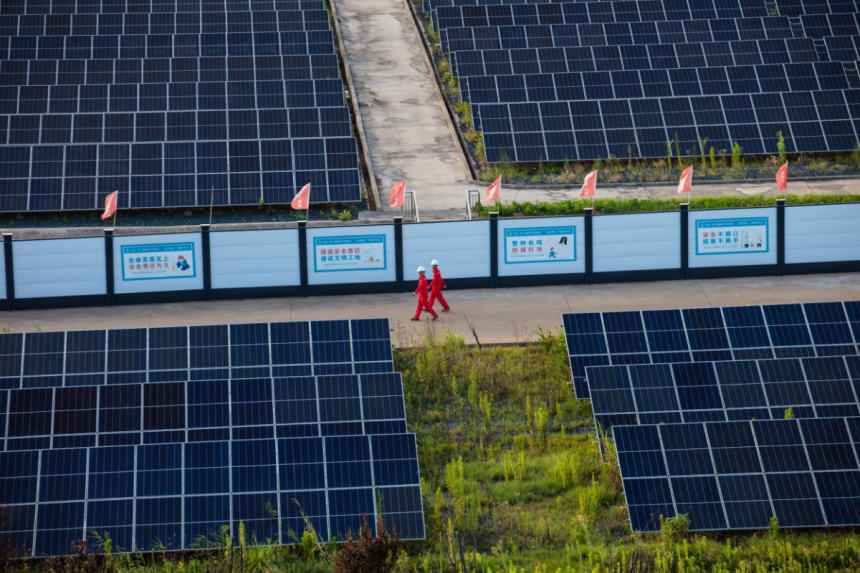
Beijing urges coordinated industry crackdown
Chinese authorities have called for “concerted efforts” to address the solar sector’s severe overcapacity, as Beijing intensifies its campaign to rein in a prolonged price war across the industry.
Officials outlined a range of proposed measures aimed at stabilizing the photovoltaic market, including stricter capacity controls, standardized industry guidance, price enforcement, accelerated mergers and acquisitions, and stronger intellectual property protection. The goal, regulators said, is to promote “high-quality development” of the solar industry.
The renewed push followed a high-level meeting involving the Ministry of Industry and Information Technology, the National Development and Reform Commission, the China Photovoltaic Industry Association, and major state-owned energy buyers such as China Huaneng Group and China Datang Corp.
Dominance meets domestic glut
China remains the undisputed global leader in solar manufacturing, producing more than 80% of the world’s solar panel components, according to the International Energy Agency. However, its production capacity now far exceeds global demand.
Intense domestic competition has triggered a race to the bottom on pricing, squeezing margins and prompting what Chinese officials have described as “involution” — destructive internal competition that undermines sustainable growth.
The government’s “anti-involution” campaign seeks to curb disorderly expansion and prevent further deterioration in profitability. Regulators have emphasized deeper inter-departmental coordination to tighten governance of the photovoltaic sector.
Global headwinds add pressure
China’s overcapacity challenge has been compounded by rising resistance in overseas markets. The United States has imposed aggressive tariffs on Chinese solar products, while the European Union has pursued efforts to diversify its renewable supply chain away from Beijing.
These trade tensions have limited export growth just as domestic output continues to surge, intensifying the imbalance between supply and demand.
Some analysts suggest that geopolitical instability in the Middle East, particularly the recent Iran conflict, could accelerate the global transition toward renewable energy as countries seek greater energy security. Higher fossil fuel prices may bolster long-term solar demand.
However, industry executives have cautioned that even a demand uptick may not be sufficient to absorb China’s excess capacity in the near term. Manufacturers have indicated that structural oversupply remains a fundamental challenge.
Balancing growth and consolidation
Beijing’s strategy signals a shift from rapid expansion to consolidation and efficiency. Encouraging mergers and tighter production discipline could reduce fragmentation and stabilize pricing, though implementation may prove complex in a sector marked by fierce competition and significant regional investment.
As China recalibrates its approach, the outcome will have global implications for solar pricing, supply chains, and the broader energy transition.